Air Disinfection in Healthcare Settings
Evidence-based continuous airborne contamination reduction as a complementary infection control measure.
Airborne transmission of infectious microorganisms is an established pathway in healthcare settings. Whilst isolation precautions, surface disinfection, hand hygiene, and vaccination remain fundamental controls, continuous air disinfection addresses airborne contamination during occupancy, a pathway that standard environmental cleaning does not address between cleaning cycles. This document outlines the evidence for AIRsteril as a complementary measure within comprehensive infection control protocols.
Clinical Context: Airborne Transmission in Healthcare
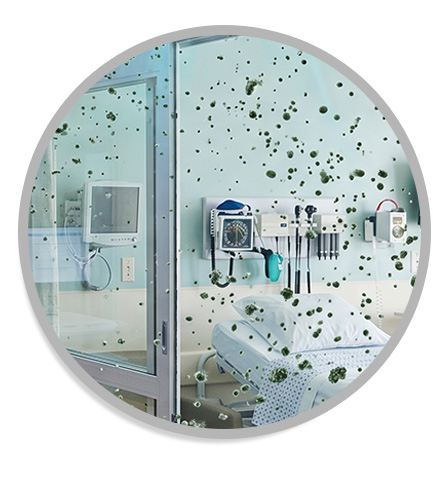
Healthcare environments present particular challenges for airborne infection control. Patients with respiratory infections generate aerosol particles during coughing, sneezing, and other respiratory activities. These particles remain suspended in air, particularly in inadequately ventilated spaces, where they can be inhaled by staff, other patients, and visitors.Standard infection control measures include isolation precautions (airborne, droplet, contact), surface disinfection, and hand hygiene. However, these measures do not continuously address airborne contamination during occupied hours. A facility operating continuously will accumulate airborne microorganisms and their byproducts throughout the day.
Aerosol Transmission: The Evidence
It is well established that infectious respiratory viruses and bacteria can travel in aerosol form and accumulate in enclosed, occupied spaces. In healthcare environments with high patient occupancy and heavy staff foot traffic, this airborne pathway is a recognised concern alongside surface and contact routes.
This demonstrates that airborne contamination is not theoretical but measurable in real healthcare environments.
Germicidal UV Technology: Mechanism and Evidence
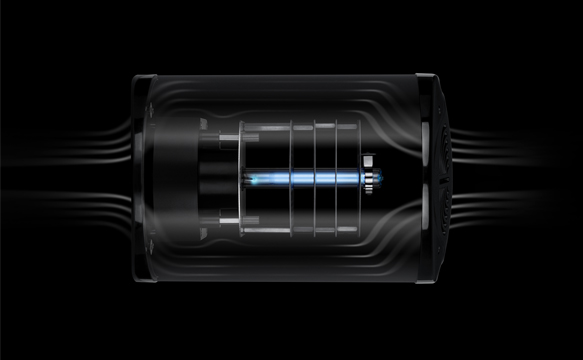
Physical Disinfection MechanismGermicidal ultraviolet radiation at 254 nanometres inactivates airborne microorganisms by damaging their genetic material (DNA/RNA). This is a physical process, not a chemical one. The mechanism is well established and has been used in healthcare settings for water treatment and controlled air disinfection applications for over a century. AIRsteril employs germicidal UV as its primary disinfection mechanism alongside other processes that contribute to overall air quality improvement.
The process is independent of antimicrobial resistance, chemical tolerance, or surface conditions. It is effective against bacteria, viruses, and fungi.
Effectiveness Against Respiratory Pathogens
Enveloped viruses, the group that includes influenza, measles, coronavirus and other respiratory microorganisms, are particularly susceptible to germicidal UV inactivation based on established disinfection science. Their lipid envelope structure makes them more susceptible than many other microorganisms, which is relevant when assessing AIRsteril performance against respiratory viral threats.
Disinfection Susceptibility Hierarchy:
More resistant: Non-enveloped viruses (norovirus, rotavirus), bacterial spores (C. difficile), mycobacteria (TB)
Generally easier to inactivate: Enveloped viruses (influenza, coronavirus, measles), Gram-positive and Gram-negative bacteria moulds.
This hierarchy is well-established in disinfection science. Enveloped respiratory viruses, the primary concern in healthcare aerosol transmission, fall into the easier-to-inactivate category.
Laboratory and Real-World Evidence
Independent Laboratory TestingHygCen GmbH Laboratory, Germany (2020)
>99.99%
reduction in airborne viral contamination (coliphage Phi-X174, a non-enveloped viral surrogate) within 10 minutes, tested across a large 75 cubic metre chamber as a whole environment rather than within the unit alone. The expert opinion concluded that comparable efficacy can be assumed for enveloped viruses, including coronaviruses.
Key point : The test used a non-enveloped surrogate that is harder to inactivate than enveloped respiratory viruses, so the reduction achieved provides a conservative estimate of effectiveness against the airborne microorganisms of greatest concern in healthcare aerosol transmission. The headline figure reflects whole-room performance, not a measurement taken inside the unit.
Real-World Evidence
Working Airport Washroom (ALS Global)
77%+
reduction in airborne microorganisms in a live, operational washroom in continuous use.
Ambulances in Active Service (ALS Global / NHS)
81%
reduction in airborne contamination measured in ambulances in active service with NHS South Central Ambulance Service.
South Central Ambulance Service NHS Trust (2015)
An NHS facility installed AIRsteril units in call centre and office areas (high-occupancy, high-stress environment with significant respiratory illness burden).
£213,704
estimated saving from reduction in sickness absence related to Cold, Cough, Flu and Chest/Respiratory problems over 9 months.
This was based on reported sickness absence data, not laboratory testing. The data was associated with reduced reported respiratory illness absence, although it was based on sickness absence reporting rather than a controlled air testing study.
Clinical Application: Where Air Disinfection Complements Infection Control
Appropriate Clinical Settings• High-risk areas: Call centres, staff rooms, administrative areas where high staff density and occupancy create conditions for airborne accumulation
• Between-isolation-cycle gaps: In facilities where isolation rooms are used sequentially, continuous air disinfection in common areas reduces airborne contamination between patient uses
• Ventilation-limited spaces: Areas where adequate outdoor air handling is difficult due to building constraints or operational requirements
• Respiratory illness control: During periods of high respiratory disease prevalence (seasonal influenza, emerging respiratory viruses), air disinfection provides an additional layer
Integration with Existing Infection Control Protocols
Continuous air disinfection should never be positioned as a replacement for established infection control measures. Rather, it is a complementary measure that addresses a specific pathway, airborne contamination during occupancy, that standard measures do not continuously address.The multi-layer approach: Isolation precautions (airborne, droplet, contact) + surface disinfection + hand hygiene + staff vaccination + continuous air disinfection = comprehensive infection control. Each layer addresses different transmission pathways. Continuous air treatment fills a genuine gap in the standard control hierarchy.
Realistic Limitations
What continuous air disinfection does not do:• Prevent close-contact transmission. If two people are in close proximity or direct contact occurs, airborne contamination reduction does not prevent exposure to respiratory droplets.
• Eliminate the need for isolation precautions. Patients with confirmed or suspected respiratory infections still require appropriate isolation based on transmission mode.
• Replace surface disinfection. High-touch surfaces still require regular disinfection as part of environmental cleaning protocols.
• Address hand-to-face transmission. Hand hygiene remains essential and is not affected by air treatment.
Evidence Summary for Infection Control Teams
Germicidal UV air disinfection is a physical, evidence-based process that reduces airborne microorganisms in occupied healthcare spaces. Laboratory evidence demonstrates reductions of 98%+ using harder-to-inactivate surrogates than respiratory viruses. Real-world healthcare data shows measurable reductions in airborne respiratory illness. The technology is complementary to, not a substitute for, established infection control measures. It addresses airborne contamination during occupancy, filling a gap in the standard infection control hierarchy. Integration into comprehensive protocols should be determined by facility risk assessment and ventilation limitations.Conclusion
For healthcare facilities with specific infection control challenges such as high-occupancy staff areas, ventilation limitations, or vulnerability to airborne respiratory disease, continuous air disinfection offers evidence-based complementary control. When integrated into comprehensive infection control protocols and positioned appropriately, it provides measurable benefit without compromising established practices.Evidence sources: HygCen GmbH laboratory testing (Test Report SN 30794, November 2020), ALS Global real-world testing in a working airport washroom and in ambulances in active service (NHS South Central Ambulance Service), South Central Ambulance Service NHS Trust sickness-absence data (2015), established disinfection science literature, and Schreck et al., "Aerosol generation in public restrooms," Physics of Fluids 33, 033320 (2021).