Why Hygiene Matters
Understanding airborne contamination, continuous air disinfection, and how air treatment complements cleaning and hygiene practice.
Note on this document: This resource is suitable for internal use and customer-facing discussions. It provides evidence-based information on virus disinfection difficulty, germicidal UV effectiveness, and the role of continuous air hygiene. Italicized sections indicate public-facing versions may emphasise these points more strongly.
The Hierarchy of Disinfection Difficulty
Not all microorganisms are equally difficult to remove from environments. Understanding this hierarchy is fundamental to understanding why certain disinfection methods work more effectively against some microorganisms than others, and why a layered approach to hygiene is essential.
Research in microbiology has established that microorganisms vary significantly in their resistance to disinfection processes. This variation is driven by fundamental differences in structure. Spore-forming bacteria, for instance, have multiple protective layers that make them extraordinarily resistant to ultraviolet light and chemical disinfectants, whilst viruses with lipid envelopes are considerably more susceptible.
DISINFECTION DIFFICULTY HIERARCHY
MORE RESISTANT TO DISINFECTION
• Bacterial spores: Clostridium difficile, C. tetanus
• Non-enveloped viruses: Norovirus, Rotavirus, Poliovirus, Adenovirus
• Mycobacteria: Tuberculosis
• Fungi and fungal spores
GENERALLY EASIER TO INACTIVATE
• Enveloped viruses: Influenza, Measles, Mumps, Coronavirus, Ebola, Nipah, Hantavirus
• Gram-positive bacteria: Staphylococcus, MRSA, Streptococcus
• Gram-negative bacteria: E. coli, Pseudomonas
Source: established disinfection science (Spaulding classification; CDC/Rutala-Weber disinfection guidance)
Key insight: Enveloped viruses, which include Ebola, coronavirus (SARS-CoV-2), influenza, Nipah, and other respiratory viruses, are among the easier microorganisms to inactivate. This is because their lipid envelope is chemically fragile and sensitive to physical disruption, including ultraviolet radiation.
Evidence for Germicidal UV Against Emerging Viruses
Germicidal UV is a long-established disinfection technology and its efficacy has been investigated across a wide range of emerging viruses. Published peer-reviewed studies have demonstrated effective UVC inactivation of enveloped viruses including SARS coronavirus, Nipah virus and Crimean-Congo haemorrhagic fever virus. These studies, conducted in controlled laboratory settings, support the long-established use of germicidal UV as a broad-spectrum disinfection technology.
The Problem: Airborne Contamination in Enclosed Spaces
Traditional hygiene practices focus on surface contamination and direct contact routes. However, research over the past several years has increasingly recognised the role of airborne transmission of infectious agents, particularly in enclosed, poorly ventilated spaces.
How Airborne Contamination Occurs
When a person coughs, sneezes, or performs routine bathroom activities like toilet flushing, they generate aerosol droplets and droplet nuclei that remain suspended in air. These particles vary in size:
• Larger respiratory droplets may settle within 1-2 metres
• Smaller aerosol particles (below 5 micrometres) can remain suspended for hours and travel much further, particularly in air currents
Research has shown that toilet flushing alone generates significant aerosol clouds that rise nearly a metre above the toilet seat and can carry infectious material. In poorly ventilated bathrooms, these aerosols accumulate over time. A peer-reviewed study of a public restroom found that after approximately 100 flushes over 3 hours, ambient aerosol levels inside the restroom increased by 209% for particles in the 0.5 to 1 micrometre range, whilst levels outside the room remained unchanged (Schreck et al., Physics of Fluids, 2021).
The Aerosol Accumulation Problem
In enclosed spaces with standard ventilation, aerosol-sized particles generated by flushing, coughing, and sneezing do not clear quickly. Even with a closed toilet lid, small particles escape. In typical commercial restrooms and offices, airborne microbial accumulation occurs throughout the day as occupancy increases.
Result: People using these spaces are exposed to a progressively higher concentration of airborne contamination, including viruses, bacteria, and their byproducts.
This reality was underestimated in early pandemic guidance, which focused predominantly on surface cleaning and direct contact transmission. We now understand that continuous air hygiene is equally important, particularly in high-traffic areas like washrooms, offices, and healthcare facilities.
Germicidal UV: How It Works
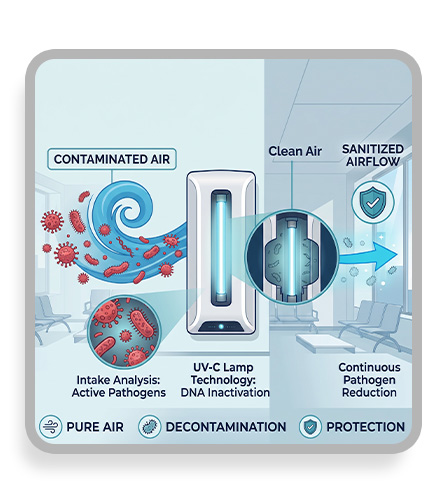
Ultraviolet radiation in the UV-C spectrum (particularly around 254 nanometres) has been proven effective at destroying the genetic material of microorganisms for over a century. This is not a new or controversial technology. Germicidal UV is widely used in water treatment, healthcare disinfection, and air disinfection systems globally.
The Mechanism
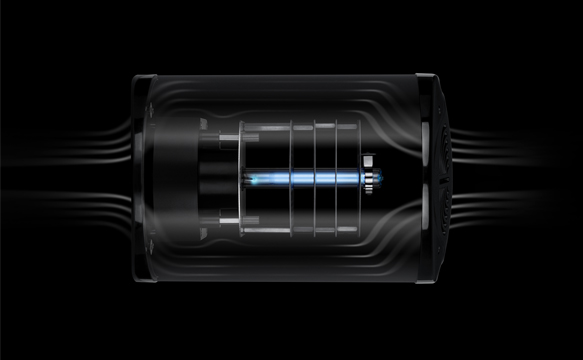
UV-C light at 254nm directly damages the DNA and RNA of viruses and bacteria by causing thymine dimer formation in their genetic sequences. This prevents the microorganism from reproducing and effectively inactivates it. The process is independent of chemical reactions or biological processes; it is a direct physical effect.
Why Enveloped Viruses Are Particularly Susceptible
Enveloped viruses, the group that includes coronavirus, influenza, Ebola, Nipah and many others, have a lipid bilayer surrounding their protein coat. Their structure makes them generally more susceptible to inactivation. UV-C disrupts the genetic material (DNA or RNA) required for viral replication. Non-enveloped viruses, by contrast, have a harder protein shell and are more resistant to UV inactivation.
This means that germicidal UV is especially effective against respiratory viruses and the enveloped viruses that travel in aerosols and respiratory droplets.
Evidence: AIRsteril Effectiveness Against Airborne Microorganisms
Laboratory and real-world testing has established the effectiveness of AIRsteril units at reducing airborne contamination in occupied spaces.
HygCen Laboratory Test (Germany, November 2020) Recent testing of the AIRsteril Multiflex was conducted in a large 75 cubic metre test chamber using airborne coliphage Phi-X174 (a non-enveloped viral surrogate).
99%
immediate reduction in viral loading upon exposure to AIRsteril-treated air
>99.99%
reduction achieved within 10 minutes
Based on the reduction rates achieved for Phi-X174, the HygCen expert opinion stated that comparable efficacy of the process can also be assumed for other viruses, at least enveloped viruses, including coronaviruses. As Ebola, Nipah, influenza and SARS-CoV-2 are enveloped viruses, they fall within the category of viruses generally expected to be more susceptible to germicidal UV than non-enveloped viral surrogates.
Reference: HygCen GmbH Laboratory Test Report SN 30794, 23 November 2020
Real-World Evidence: Working Airport Washroom (ALS Global)
Independent testing in a live, operational airport washroom measured a reduction of more than 77% in airborne microorganisms with AIRsteril in operation. This is a working environment in continuous use, not a sealed laboratory chamber.
Real-World Evidence: Ambulances in Active Service (ALS Global / NHS)
Testing in ambulances in active service with NHS South Central Ambulance Service measured an 81% reduction in airborne contamination. Again, a demanding real-world environment rather than a controlled chamber.
Real-World Evidence: NHS Call Centre and Office Settings
The use of AIRsteril units in call centres and offices at an NHS Trust was associated with a measurable reduction in illness-related absences, particularly for:
• Reported cases of colds, coughs, and influenza
• Other chest and respiratory problems
This real-world data supports the view that continuous air disinfection can contribute to measurable reductions in respiratory illness-related absence in occupied spaces.
Interpretation: The evidence shows that AIRsteril units reduce airborne microbial contamination, including viruses, across whole environments and in demanding real-world settings. The laboratory testing used a viral surrogate that is harder to inactivate than many respiratory viruses of concern, meaning effectiveness against enveloped viruses such as Ebola, coronavirus, influenza and Nipah would be expected to be at least comparable.
Addressing Current Viruses of Concern
In light of recent outbreaks and emerging threats, customers have asked about AIRsteril's effectiveness against specific viruses. The starting point is virus classification and established disinfection science; the AIRsteril test results then provide independent real-world and laboratory evidence.
Ebola Virus
Classification: Enveloped virus. Disinfection difficulty: Generally easier to inactivate than many bacterial spores and non-enveloped viruses.
As an enveloped virus, Ebola falls within the category that established disinfection science identifies as more susceptible to germicidal UV inactivation. AIRsteril employs germicidal UV as its primary disinfection mechanism. AIRsteril testing was conducted using a harder-to-inactivate non-enveloped surrogate, so the results provide a conservative basis for assessing effectiveness against enveloped viruses such as Ebola.
Nipah Virus
Classification: Enveloped virus (paramyxovirus). Disinfection difficulty: Generally easier to inactivate.
Nipah is an enveloped paramyxovirus. As an enveloped virus, it falls within the category that established disinfection science identifies as more susceptible to germicidal UV inactivation. The same reasoning applies as for Ebola: AIRsteril testing using a harder-to-inactivate surrogate provides a conservative evidence base.
Hantavirus (particularly Andes strain)
Classification: Enveloped virus (bunyavirus). Disinfection difficulty: Generally easier to inactivate than non-enveloped viruses.
As an enveloped virus, Andes hantavirus falls within the category that established disinfection science identifies as more susceptible to germicidal UV inactivation. Whilst person-to-person transmission is rare, airborne particles associated with aerosol transmission would be expected to be reduced through continuous AIRsteril operation.
SARS-CoV-2 (Coronavirus)
Classification: Enveloped virus. Disinfection difficulty: Easier to inactivate.
SARS-CoV-2 is an enveloped virus, placing it in the category established disinfection science identifies as more susceptible to germicidal UV inactivation. The HygCen AIRsteril test cited above, conducted with a harder-to-inactivate non-enveloped surrogate, provides conservative evidence of effectiveness, since the expert opinion confirmed comparable efficacy can be assumed for enveloped viruses including coronaviruses.
Conclusion: Enveloped viruses such as Ebola, Nipah, and coronavirus fall within the category that established disinfection science identifies as more susceptible to germicidal UV inactivation. AIRsteril employs germicidal UV as its primary disinfection mechanism. Independent AIRsteril testing, conducted using even harder-to-inactivate surrogates, provides substantial confidence in effectiveness against these threats.
What AIRsteril Cannot Do (Important Caveats)
Realistic Limitations
It is essential to be clear about what continuous air disinfection can and cannot accomplish:
• Close contact exposure: If two people are in direct contact in a small space, or one person is in close proximity to another actively coughing, a single AIRsteril unit will not prevent exposure to infectious droplets and particles. Masks, distance, and isolation remain the primary controls for preventing direct transmission.
• Not a replacement for cleaning: AIRsteril is not a substitute for regular cleaning and disinfection of surfaces. Contamination on doorknobs, light switches, phones, and work surfaces must still be addressed through standard cleaning practices. AIRsteril complements these measures but does not replace them.
• Ventilation matters: AIRsteril is most effective in conjunction with adequate air handling. In severely underventilated spaces, the unit must work harder to clear accumulated contamination. Proper ventilation design remains important.
• Not a standalone outbreak prevention measure: No single technology prevents outbreaks. Control of infectious disease requires multiple layers: vaccination, testing, isolation of sick individuals, hand hygiene, respiratory etiquette, surface cleaning, and ventilation/air treatment working together.
The reality: AIRsteril reduces airborne contamination significantly. In a large, well-mixed space over time, this results in measurably lower airborne microbial loads. This is valuable; it reduces the baseline risk of airborne transmission and improves overall air hygiene. But it is one layer of a comprehensive hygiene strategy, not the entirety of it.
AIRsteril's Role: Complementary to Hygiene Practice
How AIRsteril Fits Into Workplace and Healthcare Hygiene
AIRsteril is most valuable when understood as a continuous, background layer of air disinfection that works alongside, not instead of, established hygiene practices:
• Surface cleaning and disinfection: remains essential and non-negotiable
• Hand hygiene: fundamental control that AIRsteril does not replace
• Respiratory etiquette: coughing or sneezing into a tissue or elbow
• Isolation of symptomatic individuals: the primary control for preventing spread
• Adequate ventilation: essential infrastructure
• Continuous air disinfection: reduces ambient airborne contamination between these other controls
In practice: A washroom service company might equip a facility with regular cleaning schedules (removing biomatter from surfaces), staff training on hand hygiene, and an AIRsteril unit that continuously reduces airborne microbial loads during the time between cleans. This combination of regular cleaning plus continuous air disinfection maintains a higher standard of environmental hygiene than cleaning alone.
Similarly, an office or healthcare facility benefits from the baseline reduction in airborne respiratory viruses and bacteria that AIRsteril provides, without this becoming a substitute for ventilation design, sick leave policies, or isolation protocols.
Summary: Why This Matters Now
Understanding the hierarchy of disinfection difficulty, the mechanism of germicidal UV, and the role of airborne transmission helps explain why:
• Enveloped viruses like Ebola, Nipah, and coronavirus are susceptible to germicidal UV disinfection
• Continuous air disinfection addresses a genuine pathway of transmission that standard cleaning does not
• Laboratory evidence from AIRsteril testing, using harder-to-inactivate surrogates, provides solid confidence in real-world effectiveness
• AIRsteril is most valuable as a complementary measure, integrated into comprehensive hygiene strategy
• Making realistic claims about what air disinfection can and cannot do is essential for credibility and appropriate use
Bottom line: Good hygiene requires multiple layers. Cleaning, hand washing, respiratory etiquette, ventilation, and isolation of sick individuals are non-negotiable. Continuous air treatment using AIRsteril is a proven, science-backed layer that reduces airborne contamination and complements these practices. It does not replace them.
Document Purpose: This resource is designed for internal use and customer-facing discussions about air hygiene, virus disinfection, and the role of germicidal UV. It is based on published laboratory research, disinfection science, and independent testing data.
Sources: HygCen GmbH laboratory testing (Test Report SN 30794, November 2020), ALS Global real-world testing in a working airport washroom and in ambulances in active service (NHS South Central Ambulance Service), NHS South Central Ambulance Service call centre sickness-absence data (2015), disinfection difficulty hierarchy from established microbiology literature, and Schreck et al., "Aerosol generation in public restrooms," Physics of Fluids 33, 033320 (2021).